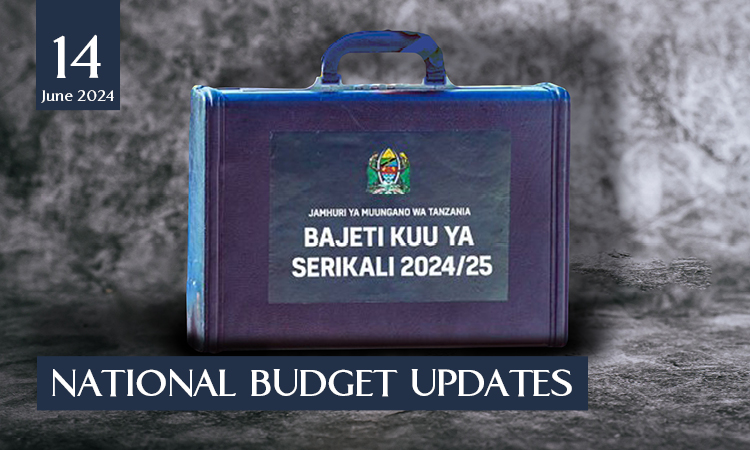

National Budget Estimates: Tanzania’s Fiscal Direction in the Next 12 Months
Pursuant to Article 137 of the Constitution of the United Republic of Tanzania and section 23(3) of the Budget Act, Cap. 439 [R.E. 2020) (the Act), the Minister for Finance, on 13 June 2024, submitted the national budget estimates (the Budget) for the year 2024/25 to the National Assembly for deliberations and approval, which set the nation’s fiscal direction in the next 12 months. . Further, upon obtaining the approval of the Budget, the Act requires the Appropriation Bill of the approved estimates to be tabled again to the National Assembly, which will eventually be enacted into the Appropriation Act to legalize and finalize the Budget approval process.
The Budget, among others, proposes to make amendments to various tax and non-tax laws with fiscal implications to the business environment and the economy at large. Below are some highlights of the major changes proposed in various laws:
- The Value Added Tax Act (the VAT Act):
- The Budget proposes to amend the First Schedule to the VAT Act so that VAT is exempted on supply of aircrafts, aircraft engines, aircraft parts, and aircraft maintenance.
- The move is aimed at attracting more investments in the aviation and tourism sectors, and enhancing competition.
- It is also proposed that VAT is exempted on supply and importation of water treatment chemicals, water meters, video assistant referee equipment and accessories.
- In order to have time certainty in the VAT refund process, it is proposed that the VAT refunds should be paid within 30 days from the date of submission of the refund application.
- The Budget proposes to have VAT, at zero rate, on gold supplied to the Bank of Tanzania (BoT) and domestic refineries, fertilizers manufactured locally for one year, and textile products made using locally grown cotton.
- In a bid to broaden the tax base, it is proposed to charge VAT on online data services.
- The Income Tax Act (the ITA):
- Proposed amendments to the ITA include adding institutions dealing with advancement of health services and environmental conservation in the list of charitable institutions so as to relieve them from income tax obligations.
- It is also proposed that tea processing companies are exempted from paying Alternative Minimum Tax requirements for three years in order to relieve the tea industry which is currently facing losses.
- The Budget seeks to introduce the Withholding Tax (at the rate of 2%) for payments received in purchase of industrial minerals, except for salt, metallic minerals or other precious minerals when sold by primary mining licensee or artisanal miner.
- The controversial section 56 is proposed to be amended to exclude its applicability on allotment of shares in resident entities in order to resolve the current interpretational challenges.
- Regarding the existing uncertainty on writing off of bank’s bad debts, the proposal is to have procedures for review and recognition of such debts prescribed in the Regulations so as to address challenges currently experienced in assessing income tax derived from loans.
- The Tax Administration Act (the TAA):
- The Budget seeks to insert a provision in the TAA that will empower the Tax Ombudsman in hearing and addressing complaints emanating from tax decisions, procedural, service and administrative matters relating to such tax decisions or objections.
- It is also proposed that the currency points be increased from TZS 15,000 to TZS 20,000 as a way of restoring the value of money over time.
- To encourage voluntary compliance, the Budget proposes to impose a maximum fine at the amount of 1000 currency points for the offense of failure to issue fiscal receipts (EFD).
- The Vocational Education and Training Act (the VETA Act):
- The Budget proposes to amend the VETA Act so that casual labourers employed in water projects managed by Water Authorities are included in the scope of Skills Development Levy exemption.
- The move is aimed at reducing project costs and enhance efficiency in water supply in Tanzania.
- The Railway Act:
- Proposed amendment to the Railway Act is to increase Railway Development Levy from 1.5% of CIF value of goods to 2%.
- The measure aims at raising funds for the development and maintenance of the railway and road infrastructure.
- The East African Community Customs Management Act (the EACCMA):
- The Budget highlights that the EAC Pre-Budget Consultative Meeting of the Ministers for Finance agreed to effect changes in the EACCMA and Common External Tariff (CET) rates for the year 2024/25.
- The proposed changes aim at achieving sustainable economic transformation through fiscal consolidation and investment in climate change mitigation and adaptation for improved livelihoods.
- As a result, changes are expected to be made to grant import duty remissions at the rates between 0% and 10% for importation of various strategic goods into the region, including lithium-ion electric accumulators, unassembled television, various inputs used in the assembling or manufacturing of mobile phones, float glasses, raw materials used to manufacture optical fiber cables, etc.
- The Export Levy Act:
- The Budget seeks to amend the Export Levy Act by introducing export levy at the rate of 10% on crude sunflower oil, sunflower cake and sunflower seeds.
- The move is mainly expected to increase government revenues.
- The Mining Act
- The Budget proposes to amend section 90A(3) of the Mining Act in view of exempting the supply of gold to the BoT from paying inspection fee of 1%.
- This follows the requirement under section 27D of the Act for establishment of the National Gold and Gemstone Reserve (under control of the BoT).
- Similarly, it is also proposed to reduce royalty rate from 6% to 2% on the supply of gold to be sold to the BoT, and such royalty paid to the gold supplied to the BoT is proposed to be treated as a final payment.
- In that regard, the Budget proposes to recognize BoT as the Statutory Gold Dealer.
- Further, the Budget proposes to amend section 87(1)(d) by reducing the royalty rate from 4% to 2% on the supply of gold to be sold to the domestic refineries.
- Furthermore, it is proposed that section 59 of the Mining Act be amended so that the mineral right holders and the mineral dealers be required to set aside minerals for in-country processing, smelting, refining and trading. The amount of minerals to be set aside will be determined by the Minister for Minerals.
- For starters, 20% of Gold will be set aside for domestic beneficiation.
- However, the requirement will not apply to mining companies having a signed agreement with the Government.
- The Government will renegotiate with mining companies for the purpose of considering the possibility of implementing this requirement of setting aside minerals for in-country beneficiation without affecting the terms to the Agreement.
- This move aims to enhance supply of gold to the BoT for growth of national gold and foreign currency reserve as well as enhancing growth of local refineries by ensuring of availability of gold stock for accreditation purpose.